
Themes of Oresteia
 Circe is a novel about power, and it depicts how the pursuit of power often leads to a cycle of cruelty. Circe is set in mythological ancient Greece and depicts the violent realms of gods and mortals, both of which exemplify the idea that in order to survive (or prosper, in the case of the immortals), one must tread on others or be trampled on. As a result, human and divine characters alike are obsessed with gaining power, and they will go to any length to achieve it.There are three roles that come into play throughout the story: power, terror, and self-preservation. Circe, the protagonist, encounters and watches each of these positions as she travels from the halls of the gods, where she is tormented and used by other immortals, to the world of people, where authority is carefully guarded.The novel depicts authority as "a great chain of fear," with each level abusing those under it in illustrating Circe's narrative. The "great chain of fear" is so ingrained in ancient Greek culture that even little disruptions can't break it. Circe is so sick of the violence she sees at the end of the story that she chooses to give up her powers and become a mortal in order to break the cycle of power and abuse.
0 Comments
Christa Wolf, a renowned East German writer, retells the narrative of the fall of Troy from the perspective of Cassandra the daughter of the Greek God Priam whose visionary powers earned her hatred. Cassandra speaks to us in a dramatic monologue whose core focus points are patriarchy and war. Wolf discusses the novel's origins in four supplementary pieces, which take the shape of reports, journal entries, and a letter. The entire collection is incisive and intelligent, and it is an urgent appeal to evaluate the past to ensure a future. The theme of fate was another component of the story that I found interesting. Cassandra has plenty of opportunities to flee or take control of her fate throughout the narrative, but she chooses not to. For example at the very beginning of the book, Cassandra told us, readers, she wanted to kill herself, but didn't. In Greek mythology, fate is frequently depicted as unavoidable. But in this case, Cassandra could have chosen her fate but did not in the end. Another theme could be the role of men and women and how they are influenced by external pressures like war. For example, on page 120, Achilles' aggression against Penthesilea's corpse, and Cassandra's observation that this was done to psychologically harm the other women as a group. Cassandra laments her brothers' "grief" and her sisters' "fear" on page 79. There are connections between Dangerous Voices and events in the novel (especially on pages 80 and 121). For more information about Christa Wolf's life and more information about her book Cassandra, I have listed a few websites Below. 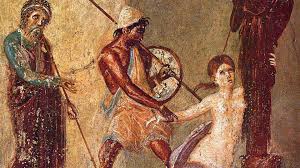 This picture is placed to represent Cassandra when she was help captive and raped by Ajax the Lesser after she was dragged from the alter of Athena.
Within all three plays I've found revenge in Agamemnon, exile in The Libation Bearers, and Justice in The Eumenides. Revenge is a common theme in the first play Agamemnon. Agamemnon is killed by his wife Clytemnestra in hope of avenging the murder of their daughter Iphigenia. Iphigenia was sacrificed to the gods for Agamemnon to sail to Troy to fight in the Trojan War. Oresteia avenges the death of his father by killing Clytemnestra in the Libation Bearers. One wrong act is being seen by another. “The slayer of today shall be slain tomorrow.” Another theme of Agamemnon is fate. Aeschylus portrays characters in Agamemnon as possessing free will. But shows life is governed by fate. Fate has ordained that Agamemnon will suffer from his ancestors' past killings. Agamemnon must abandon the war, risking being tortured by his brother Menelaus or even killed by Greek troops or sacrifice his daughter to the gods. Either way, Agamemnon suffers.
Oresteia in The Libation Bearers is in exile to return home and desire happiness again, as in a moment when his father was alive. Oresteia feels that killing his mother Clytemnestra will leave him happy but the physical act of killing left him guilty and ashamed. Oresteia feels the wrath of his mother's death from the Furries and Greek avengers chasing him. Within the final play, The Eumenides has the theme of Justice. After Oresteia kills Clytemnestra he was tormented from killing his mother. The furies and Greek avengers chased him to the shrine of Apollo. Apollo encourages Oresteia to kill so he feels obligated to help. Oresteia, the furries, and the Greek avengers agreed to hold a trial to decide Oresteia’s fate. The trial begins in front of the jury and the God of Athena. The circumstances and motivation of the crime left the jury at a tie as the God Athena decides Oresteia was not guilty. The theme of this play is justice. Old Justice “eye for an eye” without any circumstances has created a cycle of killing seen in both previous plays. New Justice is seen as putting yourself in front of a jury listening to your story and motivations of crime and deciding your fate. All three plays Agamemnon, The Libation Bearers, and The Eumenides have created a wheel of Revenge leaving the feeling of exile that ends in new Justice. |
AuthorHello my is Shelby Kerr and this blog page has been created to express my feelings on Greek Mythology and their themes. ArchivesCategories |
 RSS Feed
